
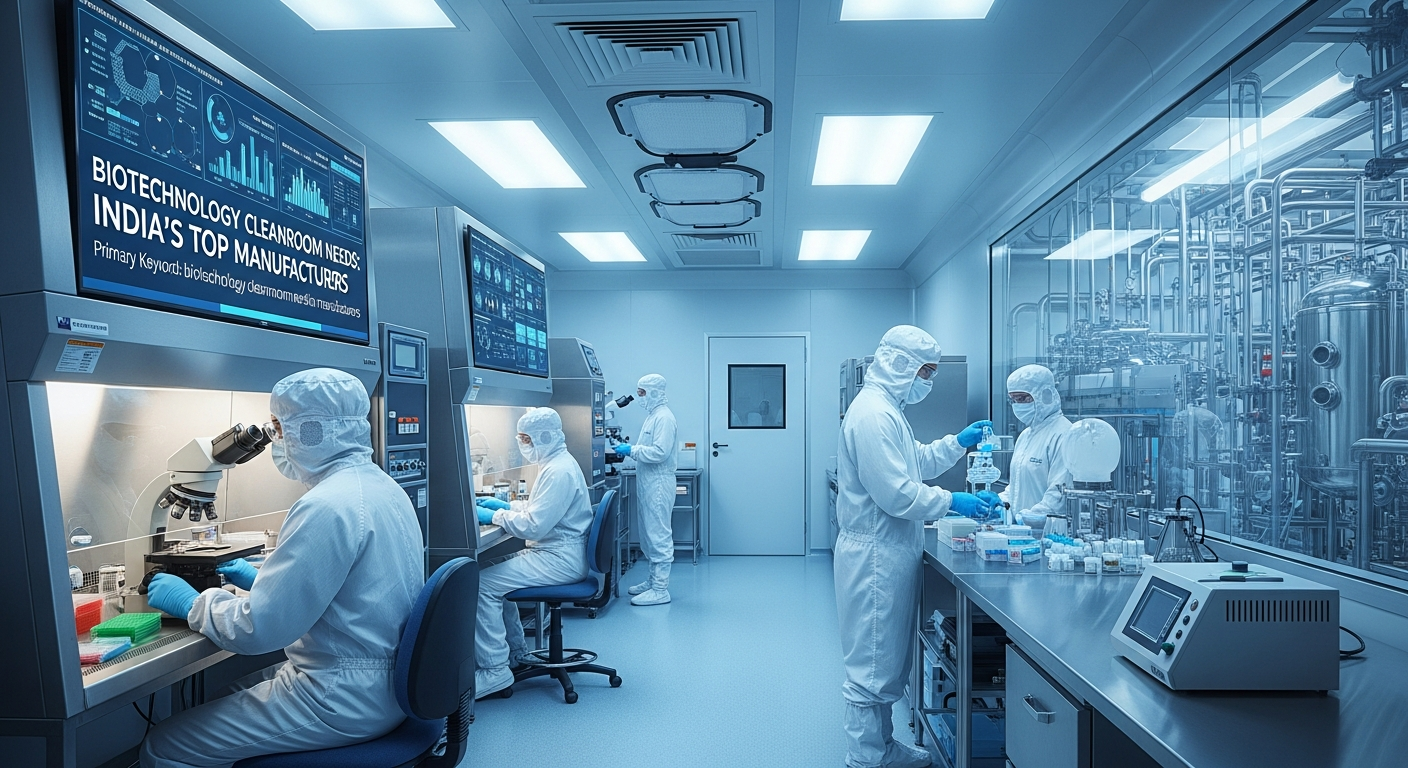
Biotechnology cleanroom needs for India manufacturers demand highly specialized, controlled environments crucial for safeguarding sensitive biological processes and ensuring product integrity. Indian cleanroom manufacturers are stepping up to meet these complex requirements, but selecting the right partner requires understanding the nuanced differences from general manufacturing. This guide helps you identify an Indian cleanroom manufacturer that grasps the critical details necessary for biotech success, focusing on what truly matters for your operations.
Why Biotech Needs Specialized Cleanrooms: Beyond General Manufacturing
Biotech cleanrooms are distinct from typical manufacturing spaces, engineered to protect incredibly sensitive biological processes. While general manufacturing aims to prevent contamination from entering a product, biotech cleanrooms must actively prevent cross-contamination between highly sensitive biological agents and maintain precise environmental parameters for living cells or delicate biopharmaceuticals. This difference is vital. For instance, a firm like 'BioGen Innovations,' developing novel gene therapies in Mumbai, needs a cleanroom that can manage various cell culture protocols (ISO 7) while also anticipating future sterile fill-and-finish needs (ISO 5). A slight deviation in temperature, humidity, or microbial presence can ruin an entire batch of valuable product or compromise critical research. Standard cleanroom protocols often fall short of these unique biotechnology demands, from cell cultures to gene therapies.
The critical role of particulate and microbial control in biotech
In biotechnology, controlling particles is essential for the survival and integrity of your product. Tiny airborne particles can carry microbes that contaminate delicate cell cultures, leading to failed experiments or unusable pharmaceuticals. The Indian biotechnology industry, a significant global player, relies heavily on product integrity. Specialized cleanrooms address this with advanced HEPA/ULPA filters, often exceeding 99.99% efficiency, and sophisticated air change rates. It’s akin to needing a surgical suite for a transplant versus a standard office – the precision required is vastly different, making this level of microbial control non-negotiable.
Distinguishing biotech cleanroom standards (e.g., ISO 7/8 for cell culture vs. ISO 5 for sterile filling)
The International Organization for Standardization (ISO) provides a framework for cleanroom classifications, but biotechnology requires a nuanced application. For example, cell culture operations, involving living organisms, might operate within an ISO Class 7 or 8 environment. However, sterile filling—the process of packaging the final product into vials or syringes—demands an ISO Class 5 environment. This is because sterile filling requires an extremely low particle count and virtually zero microbial presence to prevent contamination of the final dosage form. The cleanroom construction market in India is expanding, driven by sectors like pharmaceuticals and biotechnology, underscoring the need for these precise standards. It's not just about being "clean"; it's about being clean to the right degree for the specific process step.
Navigating India's Regulatory Landscape for Biotech Cleanrooms
When designing and operating cleanrooms for biotech in India, meticulously adhering to a framework of specific Indian biotech rules and international standards is. Meeting these requirements ensures product safety, efficacy, and market access. The Central Drugs Standard Control Organization (CDSCO) plays a key role, alongside global benchmarks like Good Manufacturing Practices (GMP) and ISO 14644.
Key Indian Regulatory Bodies and What They Mandate for Biotech Facilities
In India, several key bodies dictate cleanroom regulations for biotechnology. CDSCO compliance is critical for pharmaceutical and medical device makers, ensuring product safety and efficacy. Beyond CDSCO, the Indian Council of Medical Research (ICMR) and the Department of Biotechnology (DBT) set biosafety norms, which are crucial for research labs and advanced therapeutic facilities. Many Indian manufacturers overlook subtle regulatory interpretations specific to biotech. Simply meeting general GMP isn't enough; demonstrating control over biological agents is necessary for regulatory approval. This necessitates rigorous validation for air handling, material flow, and personnel zoning.
Meeting GMP and ISO 14644 Requirements for Biotech Production
Achieving GMP cleanrooms India standards and adhering to ISO 14644 India classifications are fundamental for biotech facility compliance. ISO 14644 establishes a globally recognized scale for measuring and classifying airborne particulate cleanliness levels. This standard is critical for defining your biotech cleanroom's acceptable contamination limits. GMP, conversely, focuses on operational processes and systems to ensure product quality and safety, encompassing facility design, maintenance, staff training, and documentation. For biotechnology, this often translates to strict aseptic processing controls and validated sterilization techniques. The Indian cleanroom technology market shows significant investment by manufacturers aiming to meet these stringent standards.
Core Components of a Biotechnology Cleanroom
A well-designed biotech cleanroom demands tight environmental control, functioning as an ultra-sterile bubble critical for preventing contamination in delicate biotech applications. The main components ensure this bubble remains intact and operates effectively, directly impacting product integrity and regulatory compliance for India manufacturers. These essential biotech cleanroom components include advanced air handling, managed material and personnel flow, and strong environmental controls.
Advanced air filtration (HEPA/ULPA) and air change rates
The cornerstone of any biotech cleanroom is its air filtration system. HEPA filters are a minimum requirement, often supplemented by ULPA filters for the most critical applications. These filters are engineered to capture 99.99% or more of particles down to 0.3 microns (HEPA) or even smaller (ULPA). Coupled with appropriate air change rates—the frequency with which air is completely replaced each hour—this system actively removes contaminants. For India manufacturers, selecting the correct filter efficiency and ensuring Air Handling Units (AHUs) can manage the necessary airflow and pressure differentials are vital. Compromising on these systems is a false economy, as they represent the primary defense against microbial and particulate contamination.
Material and personnel flow: airlocks, rapid-action doors, and gowning protocols
Controlling the movement of materials and personnel into and out of the clean area is as crucial as the air filtration itself. Airlocks serve as sterile anterooms. Personnel enter an airlock, don appropriate cleanroom attire following strict gowning protocols, and then proceed into the main cleanroom space. Rapid-action doors are frequently used in these systems to minimize air exchange when transitioning between zones. For biotechnology cleanroom needs, India manufacturers must implement clear, well-defined gowning protocols. This involves meticulous handwashing, sequential donning of sterile garments, and potentially passing through UV disinfection chambers or air showers. Ineffective flow control undermines the efficacy of even the best HEPA filters, leaving the cleanroom vulnerable to contamination.
Biotechnology Cleanroom Applications: Tailoring Design by Process
Designing a cleanroom requires precise alignment with the biological process it will house. A cleanroom for culturing delicate stem cells needs strict control over CO2 levels and humidity. Conversely, a sterile filling line prioritizes absolute sterility and rapid air changes to prevent airborne contamination of injectables. Understanding these application-specific distinctions is key for India manufacturers aiming to meet diverse biotechnology cleanroom needs, from cell cultures to high-volume Active Pharmaceutical Ingredient (API) manufacturing, ensuring both efficacy and compliance.
Cleanroom requirements for cell therapy and tissue engineering
Cell therapy and tissue engineering demand highly specialized controlled environments, maintaining precise levels of CO2, humidity, and temperature, often within an ISO 7 or ISO 8 cleanroom. The primary objective here is not solely particulate control but creating a stable, nurturing atmosphere for living cells and tissues. Preventing cross-contamination is a significant risk, necessitating strong airlocks and stringent gowning protocols. Modular cleanroom solutions are increasingly popular because they facilitate this kind of customization, acting as large-scale, high-tech incubators.
Sterile manufacturing cleanrooms: from ISO 5 to ISO 7 demands
Sterile manufacturing cleanrooms, used for sterile fill-and-finish operations or API production, prioritize achieving and maintaining extremely low levels of airborne microorganisms. Critical areas often designated as ISO 5 (Class 100)—such as laminar flow hoods or isolators where product handling occurs—are surrounded by areas that might be ISO 7 (Class 10,000). Rapid air changes, HEPA filtration, and surfaces resistant to rigorous disinfection are essential. The Indian market for these cleanrooms is strong, fueled by pharmaceutical growth. For API manufacturing, preventing both microbial and particulate contamination ensures drug purity. Molecular diagnostics cleanrooms, while also needing strict controls, may have different airflow and pressure requirements than a full sterile fill line, making ISO class comparisons vital for HVAC design and operational procedures.
New Technologies for Biotech Cleanrooms in India
Adopting advanced technologies is crucial for Indian biotechnology manufacturers to maintain competitiveness. This includes implementing real-time environmental monitoring, utilizing modular designs, and embracing single-use systems for enhanced flexibility and control, fundamentally reshaping controlled environment management.
Real-time environmental monitoring and data analytics
strong environmental monitoring systems are essential for modern biotech cleanrooms. These systems provide continuous, detailed data on critical parameters like temperature, humidity, particulate counts, and pressure differentials, going beyond periodic checks. IoT-enabled environmental monitoring is now a standard requirement for biotech cleanrooms in India, offering immediate alerts and historical data vital for compliance and operational efficiency. This data feeds analytics platforms, enabling manufacturers to identify trends, anticipate potential issues, and refine processes, thereby ensuring their biotech cleanroom technology meets stringent global standards.
The role of modular cleanrooms and single-use systems
Modular cleanrooms offer significant advantages in scalability and deployment speed compared to traditional construction. This flexibility is particularly beneficial for fast-growing biotech firms. When integrated with single-use systems—which eliminate the need for extensive cleaning and sterilization between batches—they dramatically reduce cross-contamination risks and turnaround times. This approach is especially valuable for manufacturers producing diverse biologics or handling sensitive cell cultures, allowing for faster production changes and scalable operations with reduced capital investment and downtime.
Picking Your Biotech Cleanroom Maker in India
Selecting a biotech cleanroom maker in India is a strategic decision impacting your project's long-term success. You need a partner with specialized expertise, a proven track record, and a deep understanding of the Indian cleanroom market. A thorough evaluation of their capabilities, project management approach, and commitment to quality is essential.
What to look for in cleanroom makers: skills and past jobs
When evaluating potential biotech cleanroom makers in India, prioritize their specific experience within the biotech sector. This isn't about general cleanroom construction; it's about understanding the rigorous demands of controlled spaces in drug manufacturing, medical devices, and advanced research. A strong track record demonstrates their ability to deliver quality results and ensure regulatory compliance. Critically, they must possess a deep understanding of India's specific regulatory requirements.
- Expertise: Seek manufacturers with profound knowledge of HEPA/ULPA filtration, airflow dynamics, appropriate materials for biotech applications, and ISO certifications. They should communicate effectively regarding contamination control strategies.
- Proven Experience: Request examples or references from other biotech or pharmaceutical clients in India. A history of completing projects on time and within budget indicates reliability.
- Biotech Acumen: Can they discuss specific methods for germ control, staff preparation procedures, and waste management relevant to your operations? This highlights their specialized understanding beyond basic construction.
What the project involves: from design to testing
Your chosen cleanroom maker in India should provide thorough project support, from initial design through final testing. Collaboration on the design phase is crucial to ensure the space perfectly aligns with your biotech cleanroom needs. Moreover, they must facilitate or expertly manage testing services, as cleanroom validation in India is a mandatory step for regulatory compliance.
- Design & Build Integration: Assess their ability to translate your process requirements into an efficient cleanroom design. Integrated design and build services often streamline the process and improve communication.
- Testing & Validation Support: Confirm their involvement in or coordination of essential testing phases like Installation Qualification (IQ), Operational Qualification (OQ), and Performance Qualification (PQ). This verifies the cleanroom's functionality and compliance.
- Post-Construction Support: Inquire about ongoing support, maintenance, and upgrade services. For biotechnology manufacturing partners, long-term support is vital for sustained compliance and operational excellence.
Case Study: Successful Biotech Cleanroom Implementation in India
This case study illustrates how "BioGen Innovations," a growing Indian biotech firm, successfully established a state-of-the-art cleanroom facility to support its expansion into cell therapy manufacturing. The project required a strategic approach to cleanroom implementation, focusing on specialized needs for advanced therapies.
Scenario: Scaling cell therapy production with new cleanroom infrastructure
BioGen Innovations faced a critical bottleneck: their existing laboratory space was insufficient for scaling up their novel CAR-T cell therapy production. They urgently required a dedicated, GMP-compliant cleanroom suite equipped for aseptic processing and stringent environmental controls. The primary challenges included tight timelines for investor milestones related to clinical trials, navigating India's strict pharmaceutical and medical device regulations, meeting specialized requirements for delicate cell cultures (exact temperature, humidity, particle counts), and controlling costs within their Series A funding limits.
Outcome: Regulatory approval and enhanced production capacity
Following an 18-month project, BioGen successfully commissioned its new cleanroom facility. This achievement led to crucial regulatory approval and a substantial increase in production capacity. The implementation enabled BioGen to produce batches five times larger than before, significantly advancing their clinical trial progress. This biotech cleanroom case study in India demonstrates how meticulous planning and collaboration with specialized cleanroom manufacturers can overcome complex challenges, enhancing capacity for cell therapy manufacturing in India.
Why Do Most Biotech Cleanroom Projects In India Face Delays?
Many biotech cleanroom projects in India encounter delays primarily due to insufficient upfront planning and an underestimation of validation complexity. Rushing validation to meet deadlines often results in costly rework and regulatory issues. A thorough, phased validation approach is essential for long-term compliance and avoiding project slippage. Treating cleanroom setup as standard construction, rather than a specialized, regulated build, is a common pitfall.
Common challenges: scope creep and design flaws
Scope creep, where clients introduce new requirements mid-project, significantly impacts timelines and budgets. Design flaws, often stemming from an incomplete understanding of specific biotechnology cleanroom needs for India manufacturers, also cause major setbacks.
Mitigating risks: strong validation and contingency planning
To counteract these challenges in India's biotech cleanroom sector, strong validation and contingency planning are crucial. A systematic approach to validation and proactive risk management are key.
- Phased Validation: Execute Installation Qualification (IQ), Operational Qualification (OQ), and Performance Qualification (PQ) systematically, avoiding haste between stages.
- Contingency Planning: Incorporate buffer time into the schedule for unforeseen issues, such as common supply chain disruptions impacting India manufacturers.
- Clear Scope Definition: Finalize design and requirements meticulously upfront. Implement a formal change control process for any modifications, assessing their impact on timeline and cost.
- Supplier Vetting: Partner with cleanroom manufacturers in India possessing a strong track record in the biotech sector, not just general construction. Their expertise in controlled environments is vital for avoiding design flaws and project delays. Industry data suggests that a significant percentage of cleanroom delays are attributable to inadequate upfront planning and risk assessment for specific biotechnology cleanroom needs in India.
Future Trends in Biotechnology Cleanroom Design for India
The future of biotech cleanroom design in India will be shaped by smart automation, sustainable practices, and enhanced flexibility, moving beyond static spaces to, responsive environments supporting India's rapidly evolving pharmaceutical and medical device industries. Next-generation biotech cleanrooms in India will feature intelligent systems capable of predicting environmental issues and highly adaptable modular configurations that can be quickly reconfigured as research progresses, ensuring ongoing compliance and efficiency.
The impact of AI and automation on cleanroom operations
AI integration will transform cleanroom monitoring and control. Sensors will not only detect issues but also predict their occurrence using machine learning to identify patterns and provide advance warnings before critical limits are breached. This predictive maintenance minimizes costly downtime and contamination risks. Automation also extends to robotics for material handling and sterile tasks, reducing human variability and enhancing operational precision. These advanced systems are integral to future biotech cleanroom plans.
Sustainability and green building practices in biotech cleanrooms
Sustainable cleanrooms are becoming a necessity in India, driven by environmental responsibility and cost savings. Future designs will emphasize energy-efficient HVAC systems, longer-lasting filters, and water-saving technologies. The incorporation of recycled and low-impact building materials, where appropriate, is also increasing. This commitment to green building not only enhances environmental credentials but also contributes to more cost-effective and healthier controlled spaces for India manufacturers.
Frequently Asked Questions: Biotech Cleanroom Needs in India
Who are the leading biotechnology cleanroom manufacturers in India?
When seeking top biotechnology cleanroom needs India manufacturers, several companies specialize in ISO-certified facilities. Selecting the right partner involves evaluating their specific experience with controlled environments tailored for the biotechnology sector, beyond general cleanroom construction capabilities.
What industries in India most critically require clean rooms?
Several Indian industries have critical requirements for clean rooms due to their stringent contamination control needs. Pharmaceuticals and medical device manufacturing are primary examples, where even minor particulate matter can compromise product integrity and patient safety. The biotechnology sector itself also heavily relies on these controlled environments for research, development, and production, with industry analyses consistently highlighting these sectors as leading drivers of cleanroom solutions demand in India.
How can I ensure my biotech cleanroom meets all Indian regulatory standards?
To ensure your biotech cleanroom meets Indian regulatory standards, collaborate with experienced cleanroom manufacturers in India who are knowledgeable about local compliance. Verify their adherence to standards set by bodies such as the Central Drugs Standard Control Organization (CDSCO) and relevant ISO classifications. A professional manufacturer will guide you through the necessary validation processes and documentation, confirming your facility's controlled environments are fully compliant.
What is the typical cost range for a biotech cleanroom in India for 2026?
Estimating the precise cost for a biotech cleanroom in India for 2026 is challenging without specific project details, as costs vary significantly based on the required ISO class, size, features, and materials. Expect a substantial investment, potentially ranging from several lakhs to crores of Rupees for sophisticated facilities. It is advisable to budget generously and obtain detailed quotes from multiple reputable cleanroom manufacturers in India.
Key Takeaways for Indian Biotech Manufacturers
Indian biotech manufacturers must view cleanroom strategy as a critical imperative, not merely a checklist item, for compliance, efficiency, and competitive advantage. A cleanroom is more than just a structure; it's a controlled space directly impacting product quality and brand reputation. Consequently, selecting partners with genuine industry insight and investing in scalable solutions is.
- Prioritize Regulatory Compliance: Design and build your cleanroom to meet or exceed Indian and international regulations for pharmaceuticals and medical devices.
- Engage Specialized Builders: Choose cleanroom manufacturers in India with a proven track record specifically in biotechnology and controlled environments. General construction expertise is insufficient.
- Master Airflow and Contamination Control: Invest in strong HVAC systems and filters designed to maintain the purity required for your biotech processes.
- Implement Smart Monitoring: Deploy real-time monitoring for temperature, humidity, and particle counts to ensure compliance and enable rapid issue resolution.
- Plan for Scalability: Design your cleanroom with future expansion and process changes in mind to avoid costly retrofits.
- Consider Total Cost: Factor in ongoing maintenance, energy consumption, and validation costs alongside initial construction expenses for a true cost assessment.
The Bottom Line
Biotechnology cleanroom needs in India necessitate viewing cleanrooms as strategic assets rather than mere technical requirements. For Indian biotech manufacturers aiming for global competitiveness, investing in the appropriate cleanroom setup is fundamental. This involves constructing compliant, resilient, and advanced facilities that support scientific innovation and future growth. Regularly assess how your current cleanroom aligns with your specific biotech operations and scaling objectives. Proactive evaluation today is key to sustained success.