
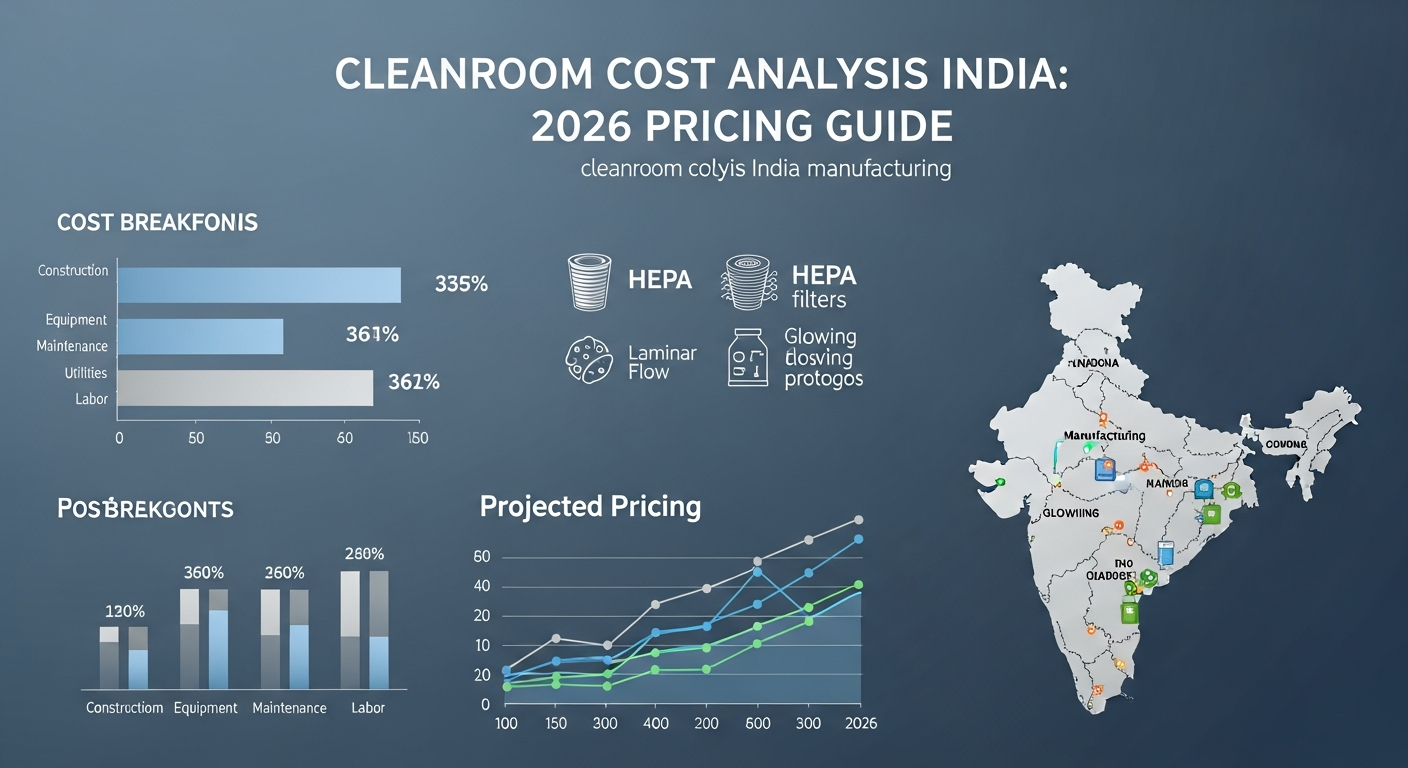
Cleanroom cost analysis India manufacturing is crucial for controlling high-stakes investments in India's booming pharmaceutical and electronics sectors. Building a critical cleanroom facility can be a significant financial undertaking, but understanding the precise costs involved ensures your project meets stringent industry standards without overspending. This guide serves as your essential roadmap for strategic financial planning of precision environments vital to India’s advanced manufacturing growth, covering everything from initial design to final installation across the diverse Indian market. Consider 'MediTech Innovations,' a hypothetical mid-sized Indian pharmaceutical company in Pune aiming to expand its sterile injectable production line. They need to build a new ISO Class 7 cleanroom, but are unsure whether to opt for a modular build or traditional construction, and how regional pricing in Maharashtra will affect their budget. This article will help them analyze the comparative costs of both methods, factor in local labor and material expenses, and estimate the operational expenditures, including HVAC and consumables, to build a detailed financial projection.
Understanding Cleanroom Costs in India (2026)
Cleanroom expenses in India are dictated by the rigor of its classification, the complexity of its systems, the construction methodology employed, and specific regulatory demands. Higher ISO standards incur greater costs due to the necessity of superior HVAC, advanced filtration, and enhanced sealing capabilities. Whether opting for a modular or a traditional construction approach also profoundly influences both the initial capital outlay and the overall project timeline.
Cleanroom Classes and Their Cost Implications (ISO 1-9)
- ISO Class 8 to ISO Class 5: These classifications are common for general manufacturing operations. The associated costs typically range from approximately $250 to $1,800 per square foot, offering a viable starting point for many businesses requiring a controlled environment without extremely stringent particle count limitations.
- ISO Class 4 or Stricter: For highly sensitive applications such as semiconductor fabrication or aseptic pharmaceutical production, costs can escalate significantly, ranging from $2,500 to $7,500 per square foot. Generally, each incremental increase in ISO class can nearly double the installed cost, reflecting the substantial investment in sophisticated air handling and filtration technologies.
Main Components: HVAC, Filtration, Walls, Flooring, and Lighting
- HVAC and Filtration Systems: These elements represent the most substantial portion of cleanroom expenses, typically accounting for 35% to 55% of the total project cost. Sophisticated systems incorporating energy recovery ventilators (ERVs) and demand-controlled filtration are essential not only for maintaining stringent air quality but also for achieving sustainability objectives and reducing long-term operational expenditures.
- Walls, Flooring, and Lighting: These structural components are vital for containing the clean environment, withstanding rigorous cleaning protocols, and minimizing particle generation. Specialized wall panels, durable epoxy flooring, and specific lighting solutions, such as low-off-gassing LEDs, all contribute to the overall construction expense for a cleanroom in India. Each material selection impacts facility longevity, ease of maintenance, and the thorough design budget.
Why Precise Cleanroom Costing Matters for Indian Manufacturers
Precise cleanroom costing is essential for Indian manufacturers, directly influencing regulatory compliance, global competitiveness, and the viability of critical investments. Without meticulous financial planning, companies risk incurring substantial expenses due to oversights, facing import restrictions, or missing lucrative market opportunities in high-growth sectors. Building a cleanroom transcends mere construction; it is a strategic financial commitment to essential infrastructure.
India's Expanding High-Tech Manufacturing Sector
The landscape for India manufacturing cleanroom facilities is experiencing strong growth, driven by substantial investments in sectors like pharmaceuticals and electronics. For instance, Micron Technology's significant investment in a semiconductor facility in Gujarat exemplifies this trend. This expansion necessitates not only physical infrastructure but also adherence to exceptionally precise environmental controls for advanced manufacturing processes. Industry projections indicate the cleanroom technology market in India is set to reach approximately USD 636.7 million by 2033, exhibiting a compound annual growth rate (CAGR) of around 9.92%. This expansion fuels the need for detailed cleanroom cost analysis India manufacturing, especially for businesses in electronics manufacturing India.
Regional Economic Disparities and Pricing Variations
A singular cost figure for cleanroom cost India is insufficient due to significant regional economic disparities that cause regional cleanroom costs India to vary considerably. Projects situated in major industrial centers like Gujarat may encounter different labor and material costs compared to those in Tier-2 cities. This factor is particularly critical for pharmaceutical cleanroom India projects, where consistency is, yet budget realities differ across states. Recognizing these localized cost dynamics is fundamental for accurate budgeting and competitive bidding processes.
The India Cleanroom Construction Cost Calculator: A Detailed Look
This section dissects the critical elements that influence cleanroom construction expenses in India, extending beyond mere square footage to encompass precision, compliance, and industry-specific requirements. We will explore benchmarks, industry nuances, and regional variations to facilitate effective budgeting for your cleanroom project in India.
Cost Benchmarks by Square Footage and ISO Class
When utilizing a cleanroom cost calculator for India, the primary cost drivers are consistently the facility's size and its required cleanliness level, or ISO class. A notable price increase is expected as you move towards stricter classifications. For example, an ISO Class 8 facility, suitable for many general manufacturing tasks, might cost between $250 and $450 per square foot, reflecting the controlled air changes and basic particle management involved. Stepping up to an ISO Class 5 cleanroom, essential for critical semiconductor manufacturing or aseptic pharmaceutical filling, elevates the cost to the range of $1,000 to $1,800 per square foot. This significant price differential accounts for the substantially more sophisticated HVAC systems, HEPA or ULPA filtration units, and extremely stringent sealing mechanisms required to prevent particle ingress. Industry data indicates a growing demand within the Indian cleanroom construction market across various sectors. Furthermore, the overall scale of the cleanroom impacts its per-square-foot cost; larger projects may benefit from economies of scale, potentially lowering the cost per square foot, although the total investment will inherently be higher due to increased volume and complexity.
Industry-Specific Pricing: Pharma, Electronics, Biotech, and More
Your specific industry profoundly shapes cleanroom requirements and, consequently, its cost. Pharmaceutical manufacturing, for instance, often necessitates compliance with Good Manufacturing Practice (GMP) standards. This can increase the cleanroom cost in India by an additional 20% to 40% compared to a standard ISO-rated cleanroom, covering extensive documentation, rigorous validation, and specialized materials. For the electronics sector, particularly semiconductor fabrication, achieving and maintaining ultra-low particle counts (such as ISO Class 3 or 4) is non-negotiable, significantly inflating costs due to advanced filtration and specialized HVAC designs critical for cleanroom construction in India. The precision demanded is immense; even minor particle contamination can compromise an entire batch of microchips. Biotechnology and medical device manufacturing also impose stringent requirements, often mirroring pharmaceutical needs for controlled environments and validated processes. Specific fit-outs, including specialized inert gas systems, unique material compatibility, or advanced monitoring, will further contribute to the overall cleanroom design cost. While a universally available online cleanroom cost calculator India might not exist, understanding these industry-specific demands is for accurate budgeting. The India cleanroom technology market is poised for substantial growth, driven by these diverse industrial needs.
Modular vs. Traditional Cleanroom Construction: An Indian Cost Comparison
When undertaking a cleanroom project in India, the decision typically involves a trade-off between speed and initial cost versus long-term flexibility and customization. Modular construction offers faster deployment and lower upfront expenses, ideal for rapid market entry. Traditional methods, while requiring more time and a higher initial investment, provide greater design freedom for highly specific requirements. MediTech Innovations in Pune faces this exact decision for their new ISO Class 7 cleanroom.
Projected Costs and Timelines for Modular Builds
Opting for modular cleanroom systems can reduce project schedules by approximately 25% to 40%, with construction being 30% to 50% faster than traditional stick-built methods. This accelerated timeline can lead to cost savings ranging from 10% to 25%. In India, modular cleanroom panels typically range from ₹25,000 per square meter for standard units with PUF insulation to specific items like a "Modular Cleanroom - 12mm Wall Panel Thickness, Grey Color" priced around ₹153,000. Over a ten-year period, a 5,000 sq ft modular cleanroom could incur costs between $2.5 million and $4 million.
Cost Factors and Lead Times for Traditional Construction
Traditional cleanroom construction generally involves a higher initial capital outlay, estimated at 15% to 30% more than modular options. However, this approach allows for highly customized designs tailored to unique manufacturing needs. Lead times are considerably longer, with project schedules potentially extending by an additional 3 to 6 months compared to modular solutions. For the same 5,000 sq ft facility over a decade, a traditional build could range from $4 million to $6 million. The Indian cleanroom construction market is experiencing strong growth, with an estimated CAGR of 8.6%, indicating substantial demand across sectors like pharmaceuticals and electronics.
HVAC Systems: The Largest Operational Cost for Indian Cleanrooms
For cleanrooms operating in India, the Heating, Ventilation, and Air Conditioning (HVAC) system is not merely a component but the most significant operational expense. These systems function continuously to maintain precise temperature and humidity levels while ensuring appropriate positive or negative pressure differentials, acting as the core of the cleanroom’s environmental control. Given India's diverse and often challenging climate, HVAC systems demand substantial energy, making efficiency a critical factor.
Energy Efficiency Considerations for Indian HVAC
Designing an energy-efficient HVAC system is for Indian cleanrooms, impacting both environmental sustainability and financial performance. India's varied climate necessitates strong cooling and dehumidification capabilities. Specifying high-efficiency chillers and air handling units (AHUs), potentially equipped with variable frequency drives (VFDs) for demand-based fan speed adjustment, is essential. Market data suggests that upfront investment in energy-efficient HVAC technology yields returns within a few years through reduced utility expenditures.
Maintenance and Filter Replacement Costs
Beyond energy consumption, ongoing maintenance of the cleanroom HVAC system is critical to ensure optimal performance and prevent costly breakdowns. Regular preventative maintenance is non-negotiable. The most significant recurring expense is typically cleanroom filter replacement. HEPA and ULPA filters often require replacement every 6 to 12 months, contingent upon the cleanroom's classification and operational intensity. Over the lifespan of the system, the cumulative cost of filter changes can substantially exceed initial installation expenses.
Government Incentives and Subsidies for Cleanroom Investments in India
The Indian government actively promotes advancements in manufacturing through various financial incentives and subsidies designed to substantially reduce the upfront costs associated with cleanroom investments. These programs aim to domestic production, particularly in high-tech industries reliant on stringent environmental controls, thereby positively impacting cleanroom cost analysis India manufacturing.
National Programs and State-Level Support Schemes
- Production Linked Incentive (PLI) Scheme: This initiative provides financial incentives to eligible companies based on incremental sales of manufactured goods, directly benefiting sectors like electronics and pharmaceuticals that depend on controlled environments.
- National Clean Production Program (NCPP): Focused on resource efficiency and eco-friendly manufacturing, NCPP can support companies investing in advanced cleanroom technology that demonstrates energy savings or waste reduction.
- State-Specific Industrial Policies: Many Indian states offer tailored incentives, including capital investment subsidies, tax benefits, and preferential loan interest rates for manufacturing projects, including those involving cleanroom construction.
Eligibility Criteria and Application Processes
Eligibility typically hinges on the industry sector, with companies in electronics, pharmaceuticals, biotechnology, and advanced manufacturing generally having higher qualification chances for government incentives. Many schemes impose minimum investment thresholds, requiring a significant commitment to cleanroom construction or technology adoption. Application submission usually involves detailed project proposals through designated government portals or state industrial development agencies, necessitating documentation on business plans, financial projections, and specific cleanroom design costs in India. Approved projects undergo verification to ensure compliance with scheme conditions, including the installation of the cleanroom and adherence to relevant standards.
Case Study: Pharma Manufacturer's Cleanroom Investment in Maharashtra
This case study examines the strategic investment by 'MediTech Innovations,' a hypothetical Indian pharmaceutical company based in Pune, Maharashtra, in a new cleanroom facility. We will detail the financial outlay, operational efficiencies, and the projected return on investment (ROI), illustrating how a well-executed cleanroom project enhances manufacturing quality and market competitiveness. MediTech Innovations is considering both modular and traditional builds for their ISO Class 7 cleanroom expansion.
Initial Investment Breakdown and ROI Calculation
MediTech Innovations’ projected initial investment for a 500 sq. meter Class 10,000 (ISO 7) cleanroom involves several key areas. For a modular build, estimates suggest a construction and validation cost of approximately ₹2.5 Crore, including specialized HVAC, HEPA filtration, airlocks, and modular panels. Procuring essential equipment like laminar flow hoods and processing machinery adds an estimated ₹1.2 Crore. Design, project management, and consultancy fees are projected at ₹0.3 Crore.
- Modular Cleanroom Construction & Validation: ₹2,50,00,000
- Specialized Equipment: ₹1,20,00,000
- Design & Consultancy: ₹30,00,000
- Total Initial Investment (Modular): ₹4,00,00,000
For a traditional build, costs could increase by 15-30%. MediTech anticipates a potential total investment of ₹4.6 Crore to ₹5.2 Crore. The projected ROI is based on anticipated increases in production yields and a reduction in batch rejections. MediTech expects a 15% rise in annual revenue within three years due to higher quality output and the capability to meet stricter international regulatory standards for exports, implying an estimated ROI of approximately 25% annually after the first year of full operation. A precise pharma cleanroom ROI India calculation must also factor in long-term compliance expenses.
Ongoing Operational Costs and Efficiency Gains
Beyond the initial capital expenditure, ongoing operational expenses are critical. For MediTech’s modular cleanroom, energy consumption for specialized HVAC systems is estimated at ₹15 Lakhs annually. Routine maintenance and recertification of HEPA filters and airflow systems add approximately ₹5 Lakhs per year. Consumables, including specialized garments, gloves, and cleaning supplies, are projected at ₹8 Lakhs annually.
- Energy Costs (Modular HVAC): ₹15,00,000/year
- Maintenance & Recertification: ₹5,00,000/year
- Consumables: ₹8,00,000/year
- Total Annual Operational Costs (Modular, excluding labor): ₹28,00,000
This case study highlights potential efficiency gains. By significantly reducing airborne particulate contamination, MediTech anticipates a 10% decrease in product spoilage and a 20% reduction in batch failure investigations. This strategic investment not only ensures compliance but also directly enhances profitability through improved product integrity and streamlined quality control processes.
Case Study: Electronics Manufacturer's Cleanroom in Tamil Nadu
This analysis focuses on the practical application of cleanroom cost analysis for Indian manufacturing, examining an electronics company establishing a facility in Tamil Nadu. We will detail their upfront expenditures and the subsequent financial benefits realized.
Cleanroom Setup Costs for Semiconductor Production
Establishing a semiconductor cleanroom in Tamil Nadu involves substantial upfront investment. This includes specialized HVAC systems for precise air filtration and temperature control, modular wall and ceiling panels, pass-through systems for material transfer, and custom furnishings. The cost for an electronics cleanroom in India varies significantly based on the required ISO class and operational scale. For a medium-sized semiconductor facility, initial setup costs could range from ₹50 Lakhs to ₹2 Crores.
Achieving Compliance and Market Entry through Cleanroom Standards
Adherence to stringent cleanroom standards is a prerequisite for market entry, especially in the electronics sector. In India, complying with ISO 14644 standards is crucial for meeting international quality benchmarks, particularly for export markets or high-end clientele. The semiconductor cleanroom in Tamil Nadu, needing to achieve ISO Class 5, found that meeting this standard was not only about quality assurance but also instrumental in securing contracts with global semiconductor brands, thereby justifying the cleanroom cost in India and significantly enhancing market access.
Long-Term Cost-Effectiveness: Quality Materials and Energy Efficiency
Investing in high-quality, energy-efficient cleanroom components in India offers significant long-term cost advantages. While premium materials and systems may require a higher initial outlay, they substantially reduce operational expenses and maintenance needs over the facility's lifespan, mitigating overall cleanroom costs in India.
Lifespan and Durability of Premium Cleanroom Materials
Superior cleanroom materials, such as high-grade stainless steel or specialized polymers for walls and floors, offer considerably longer service lives, often exceeding a decade, compared to standard materials that may require replacement every five to seven years. This enhanced durability translates directly into reduced downtime for repairs or full replacements, thereby boosting operational uptime and lowering the total cost of materials over the facility's lifecycle.
The Economic Benefits of Energy-Saving HVAC and Lighting
Implementing energy-efficient HVAC systems and LED lighting is critical for reducing operational costs in Indian cleanrooms. Standard systems can consume a disproportionately large share of the operating budget. Data from the cleanroom construction market confirms that energy consumption is a primary cost driver. Utilizing variable speed drives for fans, advanced filters requiring less fan power, and smart LED controls can reduce energy consumption by 20% to 30% or more, reallocating these savings to core manufacturing activities.
Cleanroom Consumables: A Significant Recurring Expense in India
The ongoing expenditure on cleanroom consumables represents a substantial portion of the operational budget for manufacturing facilities in India. These items are essential for maintaining the required level of environmental purity and must be replenished continuously, representing a consistent financial commitment. Overlooking this recurring expense can lead to inaccurate cleanroom cost analysis India manufacturing.
Cost Breakdown: Wipers, Garments, Gloves, and Filters
The primary spending areas for consumables include:
- Wipers: Specialized cleanroom wipers, made from synthetic materials designed for low fiber shedding and high absorbency, are used extensively. While individual wiper costs may seem minor, daily usage across a facility results in significant cumulative expense.
- Garments: Disposable or reusable cleanroom suits, hoods, shoe covers, and masks are mandatory. Costs vary based on particle shedding characteristics and required protection levels, crucial for meeting cleanroom requirements India.
- Gloves: Nitrile or latex gloves, often worn in double layers, are essential. Consistent quality and bulk purchasing can help manage costs, but regular replenishment is necessary.
- Filters: Beyond large capital equipment filters, smaller, disposable pre-filters and component-specific filters contribute to the recurring consumables budget, vital for maintaining air quality and equipment integrity.
Optimizing Consumable Buying for Indian Markets
Managing cleanroom consumables effectively in India involves smart procurement strategies that balance cost with purity standards. Opting for the cheapest options can increase contamination risks and overall cleanroom cost India. Establishing strong relationships with reputable local or international suppliers with a solid presence in India can secure better pricing and reliable deliveries. Evaluating total cost, including quality and availability, is essential. Negotiating bulk purchase agreements can significantly reduce the cleanroom consumables cost in India, contingent upon accurate demand forecasting derived from thorough cleanroom cost analysis.
Understanding the Total Cost of Ownership (TCO) for Indian Cleanrooms
The total cost of ownership (TCO) for a cleanroom in India extends beyond the initial construction price to encompass all expenses throughout its operational life, from commissioning to potential decommissioning. This holistic perspective enables more informed investment decisions, mitigating unexpected future costs and providing a true understanding of the total cost of ownership cleanroom India.
Calculating TCO: Upfront Costs vs. Running Costs
The cleanroom lifecycle cost India is broadly categorized into two main components: Capital Expenditure (CapEx) and Operational Expenditure (OpEx).
- Capital Expenditure (CapEx): This encompasses the initial investment, including cleanroom design cost India, cleanroom installation cost India, land acquisition, building materials, HVAC systems, specialized flooring, and all associated equipment.
- Operational Expenditure (OpEx): This covers the ongoing costs of running the facility, such as energy consumption (a major factor for cleanrooms), filter replacements, routine maintenance, cleaning supplies, staff training on manufacturing cleanroom requirements India, certifications, and waste disposal.
Future-Proofing Your Cleanroom Investment
Strategic long-term planning is crucial for any cleanroom investment strategy. Future-proofing involves designing and operating a cleanroom with consideration for evolving needs and technological advancements, significantly impacting cleanroom lifecycle cost India.
- Scalability and Adaptability: Ensuring the cleanroom can be easily modified or expanded to accommodate future production changes can save substantial costs and logistical challenges.
- Energy Efficiency: Investing in modern, energy-efficient HVAC and filtration systems reduces OpEx and environmental impact, a key aspect of cleanroom cost India considerations.
- Technology Integration: Designing the infrastructure to support future automation and advanced monitoring systems is more cost-effective than retrofitting later, influencing your total cost of ownership cleanroom India.
What Indian Manufacturers Must Know About Cleanroom Certifications
Obtaining and maintaining cleanroom certifications in India is critical for industries such as pharmaceuticals, biotechnology, and electronics, serving as definitive proof of adherence to stringent air purity standards. These certifications are vital for product integrity and regulatory compliance, with cleanroom certification cost India significantly impacting the overall cleanroom cost analysis India manufacturing.
Certification Fees and Audit Costs
- Initial Certification Fees: These fees, charged by the certifying body, can range from ₹20,000 to over ₹1,00,000, depending on the cleanroom's complexity and size.
- Audit Costs: Regular audits, typically conducted annually, incur costs between ₹30,000 and ₹1,50,000 per audit, covering checks on airflow, particle counts, pressure differentials, and operational procedures.
- Re-certification: Major modifications or changes in standards may necessitate re-certification, incurring costs similar to initial certification.
- Equipment Calibration: Annual calibration of critical equipment like particle counters and flow meters can cost between ₹10,000 and ₹50,000.
- Personnel Training: Training staff on cleanroom protocols and contamination prevention can add ₹5,000 to ₹20,000 per employee.
The ROI of Compliance and Market Access
Adherence to standards like ISO 14644 represents an investment rather than just an expense. The cleanroom compliance cost often yields significant returns by enabling access to markets with stringent certification requirements, such as exporting pharmaceuticals to the US or EU. It also builds trust with clients and partners. The growing cleanroom tech market indicates increasing global demand for certified facilities, making compliance a key factor for manufacturing cleanroom requirements India, directly linking to improved product quality and reduced batch failures.
Frequently Asked Questions About Cleanroom Costs in India
This FAQ addresses common inquiries regarding cleanroom investments and operations within India, covering costs per square foot, industry-specific requirements, ongoing expenses, potential incentives, and regional price variations.
What's the average cost per square foot for an ISO Class 8 cleanroom in India?
The average cost per square foot for an ISO Class 8 cleanroom in India typically ranges from approximately ₹5,000 to ₹15,000. This variation accounts for differences in materials, filtration systems, HVAC complexity, and specific manufacturing needs. Obtaining precise quotes is essential for accurate budgeting.
How much does a pharmaceutical cleanroom typically cost to build in India?
Building a pharmaceutical cleanroom in India generally incurs higher costs than a standard ISO Class 8 facility due to stringent regulatory demands and advanced technology requirements. Costs can start from around ₹10,000 per square foot and escalate significantly, potentially reaching ₹25,000 or more, depending on specific drug manufacturing processes and validation needs.
What are the main ongoing costs for a cleanroom in India?
Ongoing costs for a cleanroom in India primarily include energy consumption for HVAC and filtration systems, filter replacement, routine maintenance and calibration, cleaning supplies, and personnel gowning. Energy usage is a major factor, as these facilities are power-intensive.
Are there tax benefits available for cleanroom construction in India?
While specific tax benefits solely for cleanroom construction are not universally advertised, manufacturers may use incentives related to establishing high-tech industries or investing in designated economic zones. Exploring government schemes that promote advanced manufacturing and R&D is advisable.
How do cleanroom costs vary between major Indian cities like Mumbai, Delhi, and Bangalore?
Cleanroom costs in India exhibit significant regional variation. Major metropolitan hubs such as Mumbai, Delhi, and Bangalore often present higher construction and operational expenses compared to tier-2 or tier-3 cities, influenced by factors like real estate prices, labor costs, and local logistical challenges.
Key Takeaways for Indian Manufacturers
- A granular approach is essential for cleanroom cost analysis in India, considering size, class, industry, and regional price differences.
- Understanding how cleanroom standards impact manufacturing needs and overall spending is critical.
- Accurately budgeting for cleanroom design costs and cleanroom installation costs from the outset prevents budget overruns.
- The India cleanroom tech market influences material and labor costs.
- Global trends in the cleanroom construction market can indirectly affect project bottom lines.
The Bottom Line
Cleanroom cost analysis in India manufacturing is not merely an expense but a strategic investment. Factors such as facility size, required cleanliness class, geographic location, and ongoing operational demands collectively shape the total cost. Building a cleanroom strategically, rather than simply constructing one, is key to maximizing ROI and solidifying market position. Analyzing the primary cost drivers specific to your project is the essential first step toward achieving these goals.