
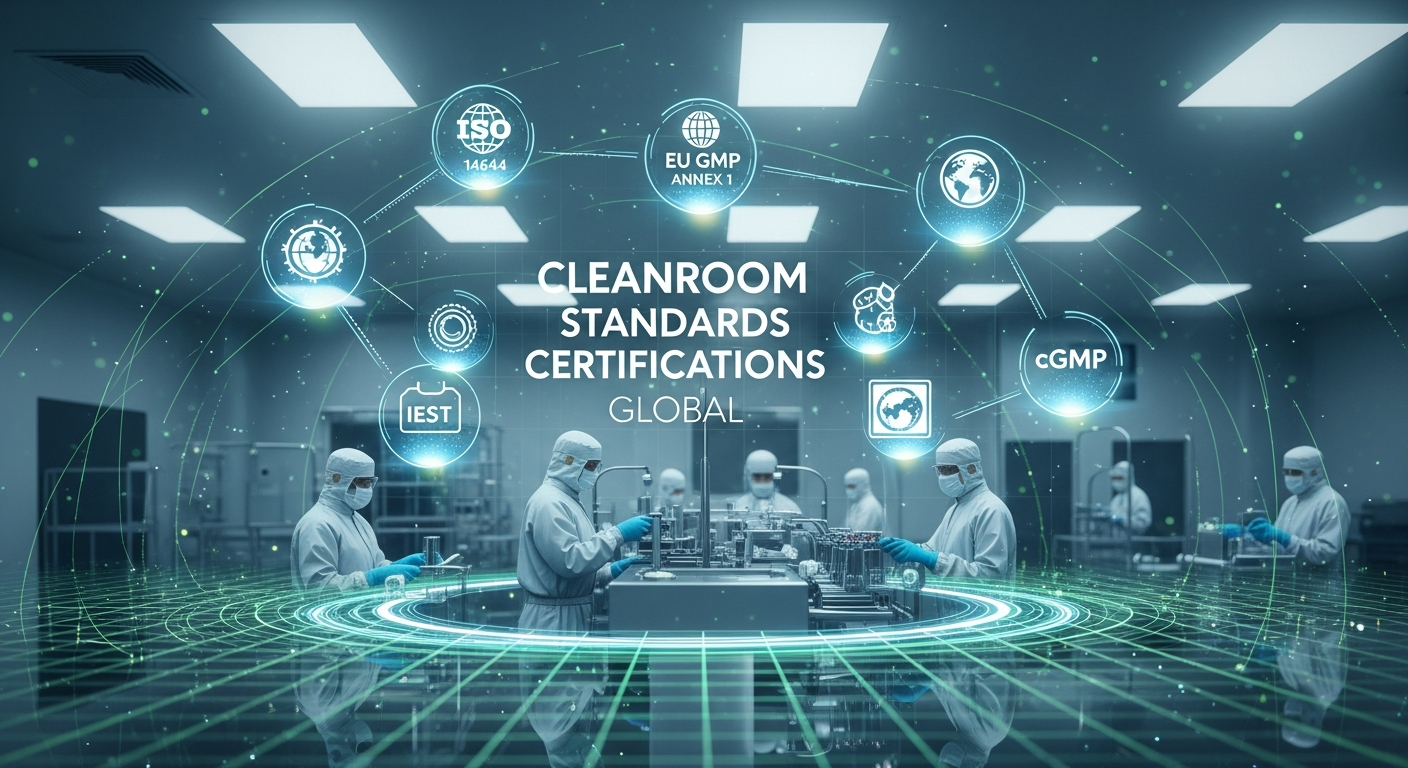
Global cleanroom standards certifications formally verify that a controlled environment consistently meets international requirements for managing airborne particles. In critical sectors like pharmaceutical manufacturing and semiconductor production, this certification is essential for ensuring product integrity, safeguarding patient safety, and achieving regulatory compliance. This guide will illuminate the journey toward understanding and achieving these vital global standards, using the example of BioInnovate Labs, a biotechnology startup aiming for certification. For BioInnovate Labs, a mid-sized biotechnology startup developing a novel therapeutic antibody, formal ISO 14644 certification is a necessary step. They operate a Class ISO 7 cleanroom for cell culture and formulation. To secure investment and prepare for US FDA and EU EMA submissions, BioInnovate must navigate the complex world of global cleanroom standards. This process will involve understanding relevant ISO 14644 parts, accounting for regional GMP expectations, and establishing rigorous ongoing monitoring.
What Exactly Is Cleanroom Certification?
Cleanroom certification is the documented process that confirms a controlled environment adheres to established standards for air cleanliness, particle counts, and operational protocols. It’s more than just maintaining a clean space; it’s about independent, objective proof that rigorous global requirements are met. These certifications are often mandatory for industries where preventing contamination is. Think of it as an independent safety inspection for your facility's controlled environment.
The Role of Formal Verification in Controlled Environments
Formal verification builds essential trust in controlled environments. It helps pharmaceutical manufacturers, biotech firms, and electronics producers to operate with confidence, assured that unseen contaminants are not compromising their processes. The global cleanroom technology market, projected to reach approximately $10.72 billion by 2026, highlights the critical importance of these environments. This process ensures adherence to standards like ISO 14644, providing an objective measure of a cleanroom's performance that internal checks alone cannot fully replicate.
Distinguishing Certification from Internal Audits
The key distinction lies in independence and scope. While internal audits and routine operational procedures are vital for daily management, cleanroom certification involves a third-party assessment against defined cleanroom standards. This formal verification is more thorough, often including Installation Qualification (IQ), Operational Qualification (OQ), and Performance Qualification (PQ) steps that extend beyond simple particle counts. Relying solely on internal checks is insufficient when product safety and regulatory compliance are at stake.
Why Do Companies Pursue Cleanroom Certifications?
Companies pursue cleanroom certifications to meet strict regulatory demands, access new markets, and build crucial client trust. These certifications demonstrate a facility's precise environmental control, directly impacting product quality and research integrity. For BioInnovate Labs, this means validating their ISO 7 cleanroom is suitable for producing a therapeutic antibody, crucial for both regulatory approval and investor confidence.
Meeting Regulatory Mandates Across Industries
Regulatory Compliance: Industries like pharmaceuticals, biotechnology, and semiconductor manufacturing operate under strict regulations. Cleanroom certification, particularly under ISO 14644, is frequently required for legal operation and product sales, providing regulators with necessary documented proof.
Product Quality Assurance: A controlled environment is fundamental for producing safe, high-quality products. Certification assures stakeholders that contamination risks are minimized, which is vital for pharmaceuticals where purity impacts drug efficacy, or for semiconductors where particles can render entire batches unusable.
Research Integrity: For research groups, maintaining experimental accuracy is. Uncontrolled contamination can invalidate results, wasting significant time and resources. Certification ensures a stable, predictable environment for critical scientific work.
Gaining Market Access and Building Client Trust
Market Access: Achieving cleanroom certification can be a prerequisite for collaborating with larger clients or entering international markets, signaling adherence to global best practices.
Client Trust: In fields with high-stakes products, clients require verifiable proof of quality. A cleanroom certification builds trust by demonstrating a commitment to maintaining top standards, safeguarding the client's own brand reputation.
Competitive Advantage: Companies that invest in rigorous cleanroom validation often stand out from competitors, making their commitment to quality a significant selling point.
Deep Dive: Understanding ISO 14644 Standards
The ISO 14644 series establishes the global benchmark for cleanroom standards, replacing older systems like U.S. Federal Standard 209E. It offers a thorough framework covering classification, monitoring, testing, design, and operation. This international standard is critical for industries where contamination control is key, such as pharmaceutical manufacturing, and forms the backbone of BioInnovate Labs' certification goal.
ISO 14644-1: Classification of Air Cleanliness
This part defines cleanroom classes based on the concentration and size of airborne particles per cubic meter. It establishes nine classes, from ISO Class 1 (cleanest) to ISO Class 9 (least clean). For example, ISO Class 5 permits no more than 3,520 particles of 0.5 microns or larger per cubic meter—a standard critical for many pharmaceutical applications. Industry projections show the global cleanroom technology market growing significantly, underscoring the importance of these standards.
ISO 14644-2: Specifications for Monitoring and Measuring
This standard outlines the requirements for monitoring and measuring to demonstrate compliance with ISO 14644-1. It specifies the frequency and parameters for testing, emphasizing that continuous or regular monitoring is essential for maintaining certification.
ISO 14644-3: Test Methods for Verification and Validation
ISO 14644-3 provides the practical methodology for verifying and validating cleanroom performance. It details specific test methods, such as particle counting and airflow pattern analysis, essential for ensuring a cleanroom operates at its declared classification. This part directly supports the certification process by standardizing validation steps.
ISO 14644-4: Design, Construction, and Start-Up
This standard addresses the initial phases of cleanroom development, covering aspects like ventilation, airflow management, and material selection to ensure the facility is built correctly from the outset to meet the intended classification. Proper design is crucial for BioInnovate Labs to establish their ISO 7 environment effectively.
ISO 14644-5: Operations and Associated Monitoring
ISO 14644-5 offers guidance on day-to-day cleanroom operations, including personnel gowning, cleaning protocols, and the necessary monitoring to sustain the specified air cleanliness class over time. Proper operational procedures are vital for BioInnovate Labs to maintain their ISO 7 status post-certification.
ISO 14644-7: Separative Enclosures
This part focuses on localized clean environments like fume hoods, glove boxes, and isolators, which protect products or personnel within a larger facility.
ISO 14644-8: Potential Contamination Classification of Molecular Substances
ISO 14644-8 addresses airborne molecular contamination (AMC), such as volatile organic compounds (VOCs), which can impact sensitive processes, particularly in semiconductor and pharmaceutical manufacturing.
ISO 14644-9: Micromechanical Particle Contamination
This standard classifies surface contamination by particles at the micrometer level, crucial for industries handling delicate components or requiring exceptionally clean surfaces.
Cleanroom Classification Explained: ISO 1 to ISO 9
The ISO 14644-1 standard defines nine cleanroom classes based on the maximum number of airborne particles allowed per cubic meter of air. Understanding these particle limits is key to meeting compliance requirements and selecting the appropriate class for specific operations, such as BioInnovate Labs' need for an ISO Class 7 environment.
Particle Limits and Measurement Criteria
ISO cleanroom classes represent a hierarchy based on airborne particle counts for particles 0.5 micrometers (µm) and larger, as defined by ISO 14644-1. The strictest class, ISO Class 1, permits very few particles, while ISO Class 9 allows significantly more. Precise measurement using calibrated particle counters validates a cleanroom’s classification. Here's a look at the particle limits for key ISO cleanroom classes (per cubic meter, for particles ≥ 0.5 µm):
ISO Class 1: ≤ 100
ISO Class 2: ≤ 1,000
ISO Class 3: ≤ 10,000
ISO Class 4: ≤ 100,000
ISO Class 5: ≤ 3,520
ISO Class 6: ≤ 35,200
ISO Class 7: ≤ 352,000
ISO Class 8: ≤ 3,520,000
ISO Class 9: ≤ 35,200,000
While these are limits for 0.5 µm particles, ISO standards also set critical limits for other particle sizes, especially for cleaner classes.
Matching ISO Classes to Industry Requirements
Selecting the correct ISO cleanroom class is critical for preventing contamination. For instance, pharmaceutical manufacturing often requires ISO Class 5 for aseptic processing, where sterility is. Semiconductor fabrication commonly utilizes ISO Class 7 cleanrooms for processes like wafer fabrication, balancing stringent control with operational practicality. BioInnovate Labs requires ISO Class 7 for its antibody production, a class appropriate for many biopharmaceutical operations, ensuring a balance between necessary cleanliness and cost-effectiveness. Other industries may find ISO Class 8 or 9 sufficient for their needs.
How Does Global Certification Vary by Region?
While ISO 14644 provides a universal framework, regional regulatory bodies and industry-specific requirements can introduce variations in cleanroom certification. Understanding these nuances is vital for international operations, impacting how BioInnovate Labs must approach compliance for both US FDA and EU EMA submissions.
North American Standards: FDA cGMP, NSF Considerations
In North America, the FDA’s Current Good Manufacturing Practices (cGMP) regulations heavily influence cleanroom design and operation for pharmaceuticals and medical devices. Compliance often means meeting both ISO 14644 and FDA expectations. The NSF also sets standards relevant to certain environments, particularly in food and water safety.
European Standards: EU GMP Guidelines and EudraLex
EU GMP guidelines, detailed in EudraLex Volume 4, govern drug production across EU member states. These guidelines are thorough, emphasizing strong quality systems, validation, and personnel training, generally aligning with ISO but with a strong focus on contamination prevention. Certification often involves inspections by national regulatory authorities.
Asian Regulatory Landscapes
Regulatory landscapes in Asia vary significantly. Japan's Pharmaceuticals and Medical Devices Agency (PMDA) and China's National Medical Products Administration (NMPA) have their own GMP rules that incorporate ISO standards. While many Asian countries are harmonizing with international norms, specific interpretations and enforcement can differ, requiring careful due diligence.
ISO 14644 vs. Other Key Standards (GMP, ISO 13485)
ISO 14644 focuses specifically on cleanroom air cleanliness classification and testing. In contrast, standards like Good Manufacturing Practices (GMP) and ISO 13485 address broader quality management systems, particularly crucial in regulated industries. These standards often build upon, rather than replace, the foundational classifications provided by ISO 14644.
Differentiating Particle-Focused ISO 14644 from Process-Focused GMP
ISO 14644 defines cleanroom classifications based solely on particle counts per cubic meter. GMP, however, is a thorough system governing all aspects of pharmaceutical product manufacturing, from raw materials to personnel training. ISO 14644 helps define the environmental requirements within a GMP framework, much like specifying air quality in a surgical theater where GMP dictates the entire surgical process.
The Role of ISO 13485 in Medical Device Cleanroom Environments
For medical device manufacturers, ISO 13485 is critical. This standard outlines quality management system requirements to ensure devices are consistently safe and effective. While ISO 14644 might define the particle count for a cleanroom used in producing a sterile implant, ISO 13485 governs the entire lifecycle of that device. Strong QMS implementation, as mandated by ISO 13485, is known to significantly reduce device recalls, reinforcing the integrated nature of quality systems and cleanroom compliance.
Who Needs Cleanroom Certification in 2026?
By 2026, cleanroom certification is crucial for any industry where particulate contamination can compromise product quality, safety, or efficacy. This extends beyond highly regulated sectors to any operation prioritizing precision and reliability. For BioInnovate Labs, certification is non-negotiable for their therapeutic antibody production.
Critical Industries Mandating Certification
Pharmaceutical Manufacturing: Essential for drug purity and preventing microbial contamination, requiring adherence to ISO 14644 and GMP.
Biotechnology Research: Vital for sensitive cell cultures and sterile drug development to prevent cross-contamination and ensure research validity.
Medical Device Manufacturing: Crucial for producing sterile implants, surgical instruments, and diagnostics, directly impacting patient safety and regulatory compliance.
Aerospace and Defense: Required for critical components where even microscopic debris can cause mission failure.
Emerging Sectors Requiring Strict Environmental Controls
Semiconductor Fabrication: Increasingly stringent particle control is needed for advanced chip manufacturing, where nanometer-sized particles can ruin entire wafers.
Advanced Materials Science: Production of next-generation composites and nanomaterials often requires controlled atmospheres to maintain material properties.
Food and Beverage Packaging: Certain high-purity food processing and packaging operations are adopting cleanroom principles to extend shelf life and ensure consumer safety.
The Cleanroom Certification Process: A Step-by-Step Guide
Achieving cleanroom certification involves a structured approach to ensure the facility meets stringent air cleanliness requirements. This process includes initial assessment, validation testing, third-party auditing, and formal certification issuance, guiding BioInnovate Labs through each stage.
Initial Assessment and Gap Analysis
The first step involves a thorough evaluation of the existing cleanroom against ISO 14644 or other applicable standards. This gap analysis identifies discrepancies and areas needing adjustment or implementation to meet specifications.
Validation Testing and Documentation
Following the gap analysis, validation testing measures the cleanroom's actual performance through airflow velocity tests, particle counts, pressure differentials, and HEPA filter integrity checks. Meticulous documentation of all test results and adjustments is essential for the certification application.
Third-Party Auditing and Certification Issuance
An independent, accredited certification body reviews the documentation and conducts on-site tests to verify impartial compliance. Upon successful completion of the audit, the cleanroom receives its certification, typically valid for a set period requiring subsequent re-validation.
Common Causes of Cleanroom Certification Failure
Cleanroom certification failures often stem from inadequate air filtration, HVAC system performance issues, and operator errors in contamination control practices.
Inadequate Air Filtration and HVAC System Performance
Filter Integrity: Compromised or improperly sealed HEPA/ULPA filters fail to capture fine particles.
Airflow Malfunctions: Incorrect airflow rates and pressure differences undermine particle control.
System Maintenance: Neglecting regular HVAC maintenance, such as filter replacement and calibration, directly impacts performance.
Operator Error and Poor Contamination Control Practices
Improper Gowning: Failure to adhere to strict gowning protocols allows personnel to introduce contaminants.
Breaches in Protocol: Unsupervised access, incorrect material handling, or skipped decontamination steps facilitate contamination.
Inadequate Training: Insufficient staff training on contamination control procedures leads to unintentional breaches.
Real-World Impact: Success Stories from Certified Cleanrooms
Companies that commit to rigorous cleanroom certification often experience direct improvements in product quality, operational efficiency, and market competitiveness.
Case Study: Pharmaceutical Company Enhances Drug Stability
A mid-sized pharmaceutical firm, struggling with inconsistent drug stability and high batch failure rates, pursued ISO 14644 certification. By rigorously controlling particles and monitoring sterile filling suites, they observed a 40% reduction in batch failures within the first year, significantly improving product quality and market reputation.
Case Study: Semiconductor Manufacturer Improves Yield Rates
A semiconductor fabrication plant implemented stringent particle control measures to achieve ISO Class 5 certification. This resulted in fewer defects during critical processes like photolithography and etching, leading to a 15% increase in first-pass yield rates and substantial cost savings from reduced material waste.
Keeping Your Certification Current: It's a Process
Maintaining cleanroom certification requires ongoing vigilance and commitment. It's not a one-time achievement but an integral part of operational quality management.
Re-certification and Routine Checks
Regular re-certification, typically annually or biennially, is necessary to keep certification valid. Routine monitoring of air particles, surface samples, and environmental conditions between official re-certifications is crucial for sustained compliance. Data from organizations like Orion Registrar, Inc. highlight the importance of continuous verification for maintaining quality certifications.
Work with Experts for Better Operations
Engaging with certification experts provides ongoing support, best practices, and insights into evolving standards. These professionals can identify potential compliance issues proactively, helping facilities adapt to changing ISO 14644 rules and avoid costly remediation efforts.
Accredited Bodies and Key Certifiers
Accredited bodies validate the competence and impartiality of cleanroom testing and certification organizations, ensuring the integrity and global recognition of cleanroom standards certifications.
How Accreditation Bodies Validate Certifiers
Accreditation bodies oversee certification companies, auditing their processes and staff to confirm adherence to international standards, thereby assuring the trustworthiness of the certification process.
Examples of Recognized Cleanroom Testing and Certification Organizations
Organizations like Orion Registrar, Inc., known for verifying certifications such as ISO 9001, demonstrate a commitment to strong quality management systems essential in sensitive environments. Other bodies, like CTCBI, also play significant roles within specific industry frameworks, ensuring that certifications are globally recognized and valid across different operational contexts.
FAQ: Your Cleanroom Certification Questions Answered
This FAQ addresses common inquiries regarding global cleanroom standards and their application, ensuring facilities meet the stringent requirements demanded worldwide.
What are the main standards for cleanroom certification?
The primary global standard is ISO 14644, which provides a thorough framework for assessing and classifying cleanrooms, covering air cleanliness, design, and operations. Industry-specific standards, particularly for pharmaceuticals and medical devices, also play a significant role.
Are ISO certifications recognized globally?
Yes, ISO certifications are universally recognized, providing a common language for quality and contamination control that facilitates international trade and builds global trust.
What is the main difference between ISO 14644 and ISO 13485?
ISO 14644 focuses on cleanroom performance and air cleanliness classification, detailing testing methods. ISO 13485 concerns the quality management system for medical devices, encompassing cleanroom requirements within the broader context of device safety and manufacturing processes.
Is cleanroom certification mandatory for all industries?
Cleanroom certification is not universally mandatory but is critical in sectors where contamination poses significant risks, such as pharmaceuticals, semiconductors, and aerospace. For these industries, certification is often a regulatory or client requirement.
How often does cleanroom certification need to be renewed?
Typically, cleanroom certification requires annual renewal, though this can vary based on industry, regulatory demands, and the specific cleanroom classification. Critical environments may require more frequent re-validation.
The Bottom Line
Integrating global cleanroom standards certifications into a business strategy is essential. Understanding ISO 14644 and its implications goes beyond mere compliance; it fosters a culture of precision that safeguards products and enhances market standing. This methodical process, from initial certification to ongoing monitoring, builds trust and provides a critical competitive edge globally.
Here's the deal:
It's critical: Global cleanroom certifications, like ISO 14644, are essential for market access and ensuring product quality.
Think big picture: Grasp all relevant ISO parts, regional differences, and maintain continuous checks.
Be proactive: Plan strategically, test thoroughly, and regularly review your validation plan to ensure ongoing compliance.