

A cleanroom that fails its first pressure check often traces back to the AHU manufacturer India you picked. An AHU manufacturer in India designs and builds air handling units for offices, factories, pharma plants, and hospitals.
The stronger suppliers size the casing, filters, and airflow to your room instead of pushing a catalogue model.
India's production-linked incentive scheme for pharmaceuticals has drawn over USD 2.4 billion in committed formulation and API capacity, and each facility needs air treatment that meets ISO 14644, the international cleanroom air-cleanliness standard.
That makes supplier choice a cost question too. Market Research Future reports that cleanroom buyers accept 2.5–3x the cost per m³/h of a comfort unit. A cheap quote can hide a unit that won't hold spec, and fixing that later costs more.
1. What Is AHU manufacturer India?
An AHU manufacturer in India builds the factory-made unit that moves and treats air for a building or plant. The maker fits the fan, coils, filters, and dampers into one casing before the unit ships.
That factory step decides most of what you get on site.
The industry definition of a central station unit describes this kind of encased assembly, and it's a useful yardstick when you compare quotes. Energy recovery devices, mixing dampers, and filters are usually built in at the works, not added later.
That's where the factory build pays off. A unit that arrives assembled needs far less fieldwork than one pieced together on a crowded site.
Modular units solve the access problem. When a door or shaft is too small, the crew brings the unit in as sections and joins them on site.
Which companies manufacture AHUs in India, and where are they based?
Indian makers range from small custom shops to large factories, so the list is wide. Evapoler is one name to check first, with custom-built, floor-mounted, and vertical double-skin units in its catalogue.
- Evapoler: published industrial range runs from 5,000 to 40,000 CFM (cubic feet per minute, a measure of air volume).
- Edgetech: check its range directly before shortlisting it for smart or cleanroom units.
Plant locations vary, and a maker's head office often sits in a different city from its works. Ask for the factory address in writing, because that's where your unit will actually be built and tested.
What types of AHU are available: double-skin, floor-mounted, ceiling-suspended, and cleanroom?
Four types cover most Indian projects, and each one solves a different space or hygiene problem. The right type usually follows from where the unit will sit and what air quality the room needs.
| Type | Typical use | What sets it apart |
|---|---|---|
| Double-skin | Hospitals, labs, food plants | Two metal skins with insulation between them; Evapoler lists 25 mm double-skin panels |
| Floor-mounted | Plant rooms with floor space | Sits on the floor, easy to reach for service, suits large airflows |
| Ceiling-suspended | Offices and tight plant rooms | Hangs from the ceiling to free up floor area |
| Cleanroom | Pharma, electronics, biotech | Sealed casing with HEPA (high-efficiency particulate air) filters that trap very fine dust |
Double-skin panels cost more than single-skin ones. They resist condensation and are easier to keep clean, which is why hospitals and food plants often insist on them. Don't pick a type by looks; pick it by the room's job.
What does an AHU cost in India, and what drives the price up or down?
An AHU's price depends on its airflow, its build, and the parts inside it. No single figure fits every project, so get quotes against the same spec sheet or the numbers won't compare.
- Airflow and cooling capacity: more CFM and more tons means bigger fans, larger coils, and a bigger casing.
- Panel construction: double-skin insulated panels add cost over single-skin sheet.
- Fan and motor: AMCA-certified fans (tested by the Air Movement and Control Association) and IE3 motors (a premium efficiency class) add upfront cost but cut power bills.
- Filtration grade: higher-grade filters and cleanroom sealing push the price up.
- Customization and controls: non-standard sizes and smart controls add engineering time.
- Certification: test reports and compliance paperwork add cost, but your project may require them.
The cheapest quote often hides the costliest part. A lower-grade motor saves money on day one and costs more in electricity every year it runs. Compare quotes line by line on fan type, motor class, panel thickness, and filter grade.
How do you choose a manufacturer based on application, CFM or cooling capacity, and climate?
Start with the application, size the airflow and cooling load, then check how the unit handles your local climate. Those three steps cut a long list down to a few serious bids.
Sizing comes first. Specifying Engineer's overview of AHU types puts fan coil units at roughly 200 to 1,200 CFM, while packaged rooftop units reach tens of thousands of CFM. Cooling is measured in tons, where one ton equals 12,000 Btu (British thermal units) per hour.
Once the size is clear, Airtree HVAC's guide to Indian AHU makers lists criteria worth scoring each maker against:
- Customization: can they change the size, layout, and connections to fit your room?
- Energy efficiency: do they use efficient fans and motors?
- Build quality: check panel thickness and casing finish.
- After-sales support: who services the unit, and how fast can they respond?
- Compliance: do they supply test reports that meet your project's codes?
Climate changes the spec more than most buyers expect. Humid coastal sites and the monsoon season need more cooling coil rows and better condensate drainage. Dry inland sites shift the load in a different direction.
Ask each maker to rate the unit at your site's design conditions, not a generic test point. A hospital ward and a warehouse can share the same airflow and still need different units.
Which manufacturers specialize in cleanroom, pharma, or healthcare AHUs?
Cleanroom, pharma, and healthcare AHUs are a specialist job, so check each maker's range for those units before its general catalogue. A general-purpose unit with a cleanroom label often lacks the sealed casing and filter access those rooms need.
Check each maker's own catalogue for cleanroom and healthcare units before you add it to a bid list, because a brochure claim and a tested unit aren't the same thing.
For cleanroom HVAC specifically, see our guide to top cleanroom manufacturers in India.
Ask every specialist for HEPA test reports and pressure differential records. Pressure differential is the small air-pressure gap between rooms that keeps dust moving in one direction.
You'll find that a healthcare ward and an operating theatre need different controls, so don't accept one spec for both.
2. How Does AHU manufacturer India Work?
An AHU is a factory-built box that moves air through a fan, across heating or cooling coils, and through filters. Some AHU makers build the whole assembly in their own workshops, so the fan and coils can arrive as one unit.
The order of parts inside the box matters. According to PDH Online's engineering course on air handler rightsizing, a blow-through unit places the coil downstream of the supply fan, while a draw-through unit places it upstream.
Your supplier should tell you which layout they use and why.
Capacity starts with airflow, and the common rule of thumb is about 400 CFM (cubic feet of air per minute) for every ton of refrigeration, or cooling capacity.
The same PDH Online course notes that standard units range from about 2,000 CFM modular units up to 30,000 CFM and larger custom builds.
Airflow sets the fan size and the unit's footprint. The fan also has to overcome static pressure, the resistance that ductwork, bends, filters, and coils add to the air path.
A fan that's too small for the duct run won't deliver the airflow on the drawing.
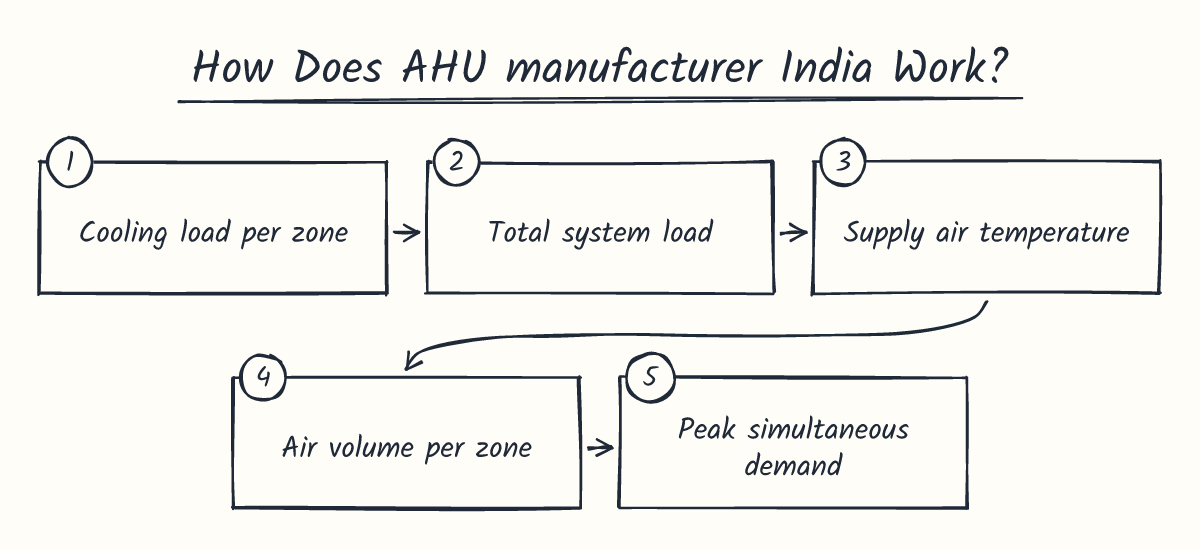
Correct sizing follows five steps, and you'll want a supplier who walks you through each one:
- Calculate the cooling load for each zone.
- Add the load from outdoor air to get the total system load.
- Set the supply air temperature using psychrometric calculations, the math of air's heat and moisture.
- Work out the air volume each zone needs, which decides the diffuser selection.
- Add up the peak simultaneous demand to size the AHU and the central cooling plant.
Rightsizing, not oversizing, keeps life-cycle cost lowest. Oversizing feels safe, but it's the expensive mistake. A bigger fan and coil use more power for the life of the unit.
Indian makers publish their own ranges, and they vary widely. Peter Air, an Indian manufacturer, lists its published ranges from 500 to 200,000 cubic metres per hour (CMH). Its pressures run from 25 to 200 mm WG (millimetres of water gauge).
Its units also offer multi-stage filtration, from pre-filters to HEPA (high-efficiency particulate air) filters.
If the AHU feeds a cleanroom, filter stages and pressure matter even more. The cleanroom design layout guide explains how the room's layout shapes those choices.